We are standing at the threshold of construction’s third industrial revolution. First concrete. Then steel. And now, mass timber.
by Nick Milestone, COO, Mercer Mass Timber
This moment is the most exciting of my career. The convergence of performance, prefabrication and sustainability has created an undeniable momentum. The tipping point for mass timber in North America’s built environment has arrived.
I entered the construction industry as a teenager growing up in Northern England, when thanks to my grandfather, a site carpenter, I landed my first job. From there I moved into the steel industry in the early 1990s, earned three relevant degrees, and all the while, paid careful attention to what was happening across Europe.
In the early 2000s, Central Europe saw the birth of cross-laminated timber (CLT) — a response to declining rural economies and abundant forest resources. Engineers, researchers, and manufacturers came together to form a new material system that was strong, light, renewable, and efficient.
Within a decade, it had taken hold across the continent and crossed the Channel to the UK. I followed its trajectory closely and eventually transitioned into the relatively new, inspiring space. Mass timber has sent me to build projects the world over.
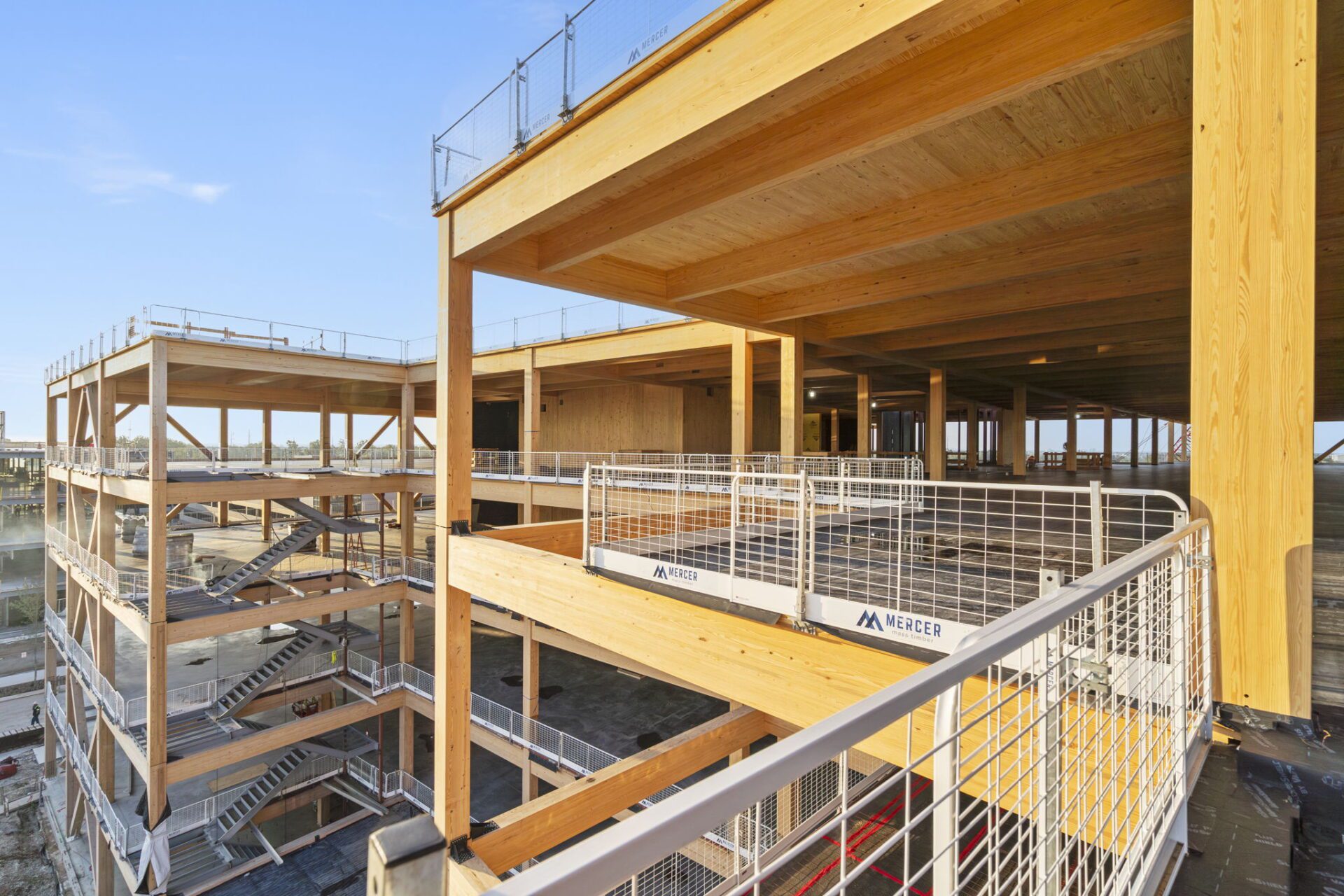
I waited 30 years to deliver a significant project in the U.S. though, and when the opportunity arose, it was certainly worth the wait—the new Walmart headquarters in Bentonville, Arkansas, the largest mass timber corporate campus in the country.
From order to site, the project took just 40 weeks to complete. Forty weeks! That’s from 3D modeling to fabrication, assembly, delivery, and installation. That kind of delivery speed is not just impressive, it’s transformative.
Walmart’s HQ represents a beautiful convergence of conventional and innovative materials, proving that steel and mass timber are not in competition, but in concert.
Here’s what excites me:
Mass timber brings speed to market: Prefabrication reduces construction schedules by up to 25%, which means a faster ROI.
Mass timber balances the volatility of steel: While steel prices can fluctuate, mass timber has shown resilience and price stability.
Mass timber creates true carbon neutrality: In hybrid structures, mass timber offsets the carbon load of steel, creating balanced systems.
Mass timber is a protector: It burns on the surface, forming a protective layer of char that slows fire spread and shields deeper
structural components from damage.
Today, over 30 million square feet of mass timber construction exists in the U.S. By 2030, that figure is expected to reach 80 million. Mass timber now exists in all building typologies, from commercial offices and schools to healthcare facilities and housing.
We are not waiting for a future where mass timber is mainstream. We are living it today.
Winston Churchill once said, “To understand the direction of your future, you need to understand your past.”
The past taught us how to mine for minerals and build with concrete and steel. And today, as we innovate and even regenerate, we continue to expand the possibilities in the realm of construction. Hybrid projects are faster, smarter, and more sustainable than ever before, and the symbiotic nature of steel and mass timber represents the future of construction in North America.
Mass timber’s moment has arrived indeed.
Unlock the full article now
Fill out the form below to access the full article, delivered straight to your inbox. You’ll also receive exclusive updates from our experts.
By submitting, you agree to our privacy policy and will get commercial communication from Mercer International. We respect your privacy and won’t share your data without consent. Unsubscribe anytime.
We use them to give you the best experience. If you continue using our website, we’ll assume that you are happy to receive all cookies on this website. Learn more about our Privacy Policy.